From Flowers and Butterflies to a Hatchet: How VR Helped a 56-Year-Old Stroke Patient Regain Her Independence
Case Study – VR Vitalis® Pro
Uherské Hradiště Hospital
From Flowers and Butterflies to a Hatchet:
How VR Helped a 56-Year-Old Stroke Patient Regain Her Independence
Quick Summary
A 56-year-old patient suffered an ischemic stroke that left the left half of her body paralyzed. Thanks in part to virtual reality (VR Vitalis) being built into a comprehensive rehabilitation plan at Uherské Hradiště Hospital, she not only regained the fine motor skills of her hand but also overcame her initial depression. She left the hospital able to walk on her own with a single forearm crutch.
An Unexpected Turn and a Difficult Start
In early 2025, the 56-year-old patient was hospitalized for high blood pressure (220/105). Within a few days she unfortunately developed an ischemic stroke (CVA).
The consequences were serious:
- The patient had moderate paralysis of the left arm, weakness of the left leg and a complete loss of sensation on the left side of her body. Her gait was highly unstable, pulling her to the left, and required the support of a high walker as well as a physiotherapist in constant attendance.
- On top of that, the inability to grip normally, poor movement targeting and the sudden loss of independence understandably left the patient in a depressed state of mind.
From Catching Butterflies to Chopping Wood: The Course of Therapy
Miroslava Havlíčková, a physiotherapist at Uherské Hradiště Hospital, put together an intensive and comprehensive rehabilitation plan. Part of it was daily training in virtual reality using the VR Vitalis® system.
Virtual reality allowed the patient to leave her hospital room for a completely different, stimulating environment. This brought several key benefits:
Diverting attention: During exercise, the immersive environment kept her brain busy with sensory input. She loved taking in the vibrant savannah. She kept returning to the outer-space environment, which she used to relax and deepen her breathing.
Better movement targeting and motor skills: The patient started with gentle, flowing movements – in the virtual world she caught butterflies and watered flowers, for example. Step by step she worked her way up to dynamic, strength-based movements such as chopping wood with a virtual hatchet, set in a forest with birdsong in the background. Speed and accuracy training was another favorite program. Every following day she would rate her own success and choose an ever higher level of difficulty. Her greatest challenge was the door-opening program, which really does call for a certain dexterity, agility and good fine motor skills.
Cognitive training: As part of her training she used the shopping program, raising the level of difficulty by shortening the time available to memorize the items.
A psychological boost: The immediate visual and audio feedback in the game was a huge motivator for the patient and helped her shake off her initial depression.
Measurable Results and a Return to Everyday Life
After just under a month of hospitalization and intensive therapy, the results were plain to see. Movement targeting, fine motor skills and the overall grip strength of the left hand improved markedly. Sensation in the limbs on the left side was also gradually restored.
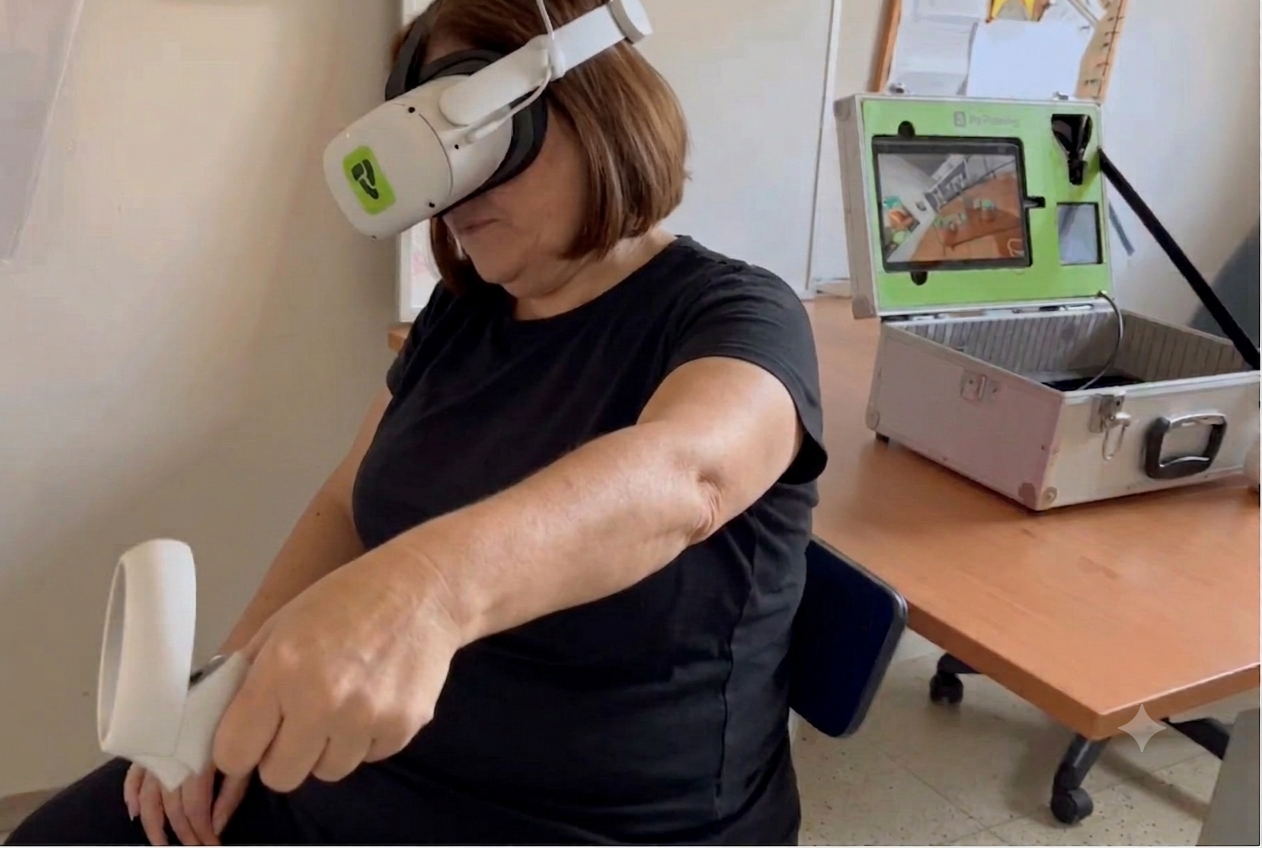
The greatest success, however, was the return of independent mobility. The patient, who at the outset could walk only with support and an escort, left the hospital able to walk on her own with just a single forearm crutch (over short distances even with no support at all). She was psychologically settled, motivated and ready for follow-up care at a specialist treatment institute.
"Virtual reality transports the patient into a different environment, keeps the brain busy with sensory input and can partially suppress pain. The immediate feedback it provides is a major benefit for physiotherapy."
